Last July, in "The Silver Mountain and the Billion-Dollar Man", we argued that Meta's eye-watering AI salaries were one of the most cold-bloodedly rational bets of the century.
These salaries for the top 50-100 AI researchers, paid out over a few years and linked to Meta's stock performance, are perhaps the most cold-bloodedly rational business decision of the 21st century.
Nine months later, the receipts are arriving.
The Timing That Felt Too Neat
Meta already had the mountain: a cathedral of silicon, oceans of data, global distribution, and one of the best advertising engines ever built. What it lacked was the catalytic input.
One day after our piece ran, Mark Zuckerberg published "Personal Superintelligence". He wrote that Meta's goal was to bring personal superintelligence to everyone, distinct from competitors who want to centralize it for automation, and that glasses which can see what we see and hear what we hear could become the primary computing device.
Meta: Personal Superintelligence
With the strategy articulated, the acquisitions came quickly to back the vision. The $14.3 billion Scale AI deal brought Alexandr Wang in to run Meta Superintelligence Labs (MSL) and locked up a critical data-labeling pipeline. In December, Meta acquired Manus for over $2 billion, the Singapore-based agent firm whose general-purpose agents handle multi-step real-world tasks. Dreamer, the second agent acquisition, added long-horizon reasoning to the stack.
On the Q4 2025 earnings call, Zuck guided to $115–135 billion in 2026 capex and spoke explicitly about Meta Compute, long-term silicon and energy investments. Infrastructure as a strategic advantage. (In the Q1 2026 print, the company raised that range to $125–145 billion.)
The Hyperion datacenter in Richland Parish, Louisiana, whose footprint covers a significant part of Manhattan and is scaling toward 5 GW, is the clearest symbol. The company is building out the campus on roughly 4,000 acres, and has ordered 10 gas-fired power plants with 7.5 GW combined capacity to supply it — an increase equivalent to more than 30% of Louisiana's current grid.

Talent, data, agents, glasses, and the factory to run them on. The pieces of the personal-superintelligence stack started falling into place.
Muse Spark and the Wrong Scoreboard
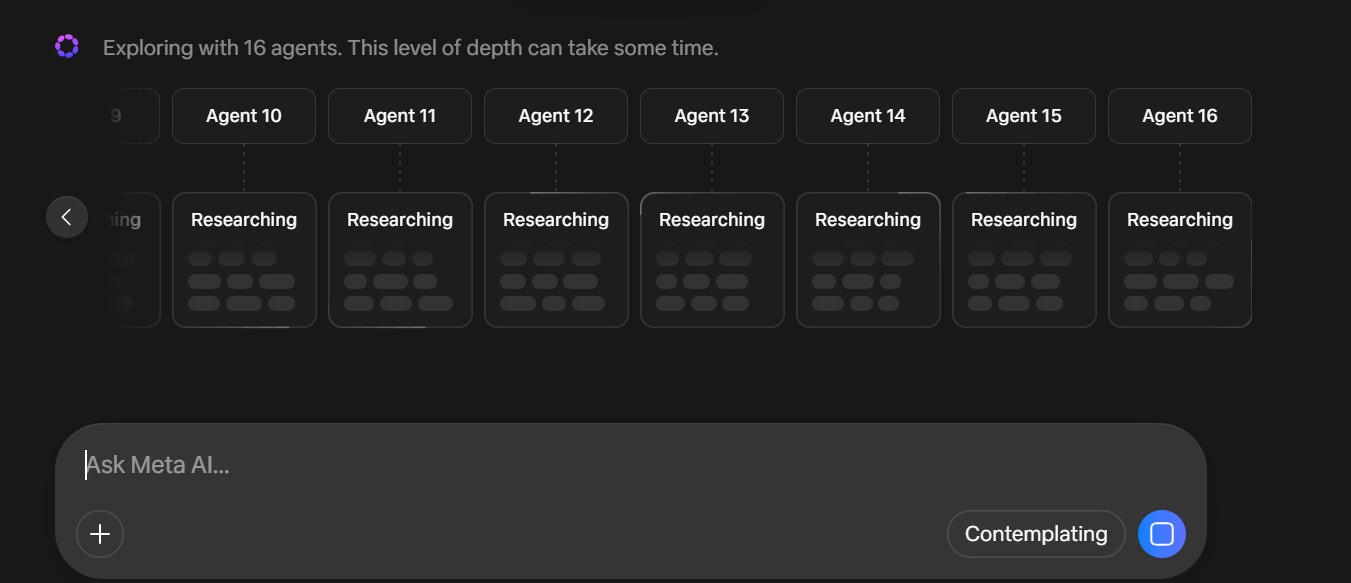
Last week we saw the first real yield. On April 8, 2026, Meta introduced Muse Spark, the first model from the new lab. It is natively multimodal, purpose-built for Meta's surfaces, and already rolling out to the Meta AI app, website, and (in coming weeks) WhatsApp, Instagram, Facebook, Messenger, and Ray-Ban Meta glasses. Meta says larger models are already in development.
Leaderboards invite benchmark comparison. The new model trails leaders on pure coding depth and abstract reasoning proxies like ARC-AGI 2. But that is the wrong scoreboard for Meta. Muse Spark is competitive in multimodal tasks, health reasoning, and visual understanding, the areas that matter for Meta's consumer products.
Its natural contest is not "best model in a tab." It is "best multimodal consumer intelligence layer sitting on top of the biggest social and media surfaces on earth."
That is where Muse Spark starts to make sense. The use cases for Meta are shopping with context from creators and communities, and surfacing recommendations directly inside the answer.
3.5 billion people already spend hours a day on Meta's surfaces. Meta AI already reports more than 1 billion people using it every month (and the company has since indicated 1.2 billion in Q1 2026), and the number Meta cares about is not which chatbot they chose. It is that every interaction, whether a question asked in WhatsApp, an image reverse-searched on Instagram, a product query on Facebook Marketplace, or a look-up on the glasses, feeds the intelligence layer that decides what appears next in the feed.
A user asks Meta AI to help replace a broken coffee machine. The agent reasons about kitchen size, prior brand loyalty, pod versus drip, and budget. Each inference is a fresh row in the ad ranker's dossier. Within a day, a coffee machine ad appears on Instagram, and the ranker knows more about that user than it did yesterday. The model produced the conversation. The conversation produced the dossier. The dossier is what pays.
This is why Muse Spark is the point and the chatbot race is not. Better dossiers mean more relevant ads. More relevant ads mean Meta can show fewer of them and still lift revenue per user, which protects the feed experience. A more pleasant feed, backed by better targeting, is the flywheel. Every time the AI layer sharpens, the ads feel more tailored to you and more effective at the same time, and the user has one more reason to stay on the surface and to open the next one.
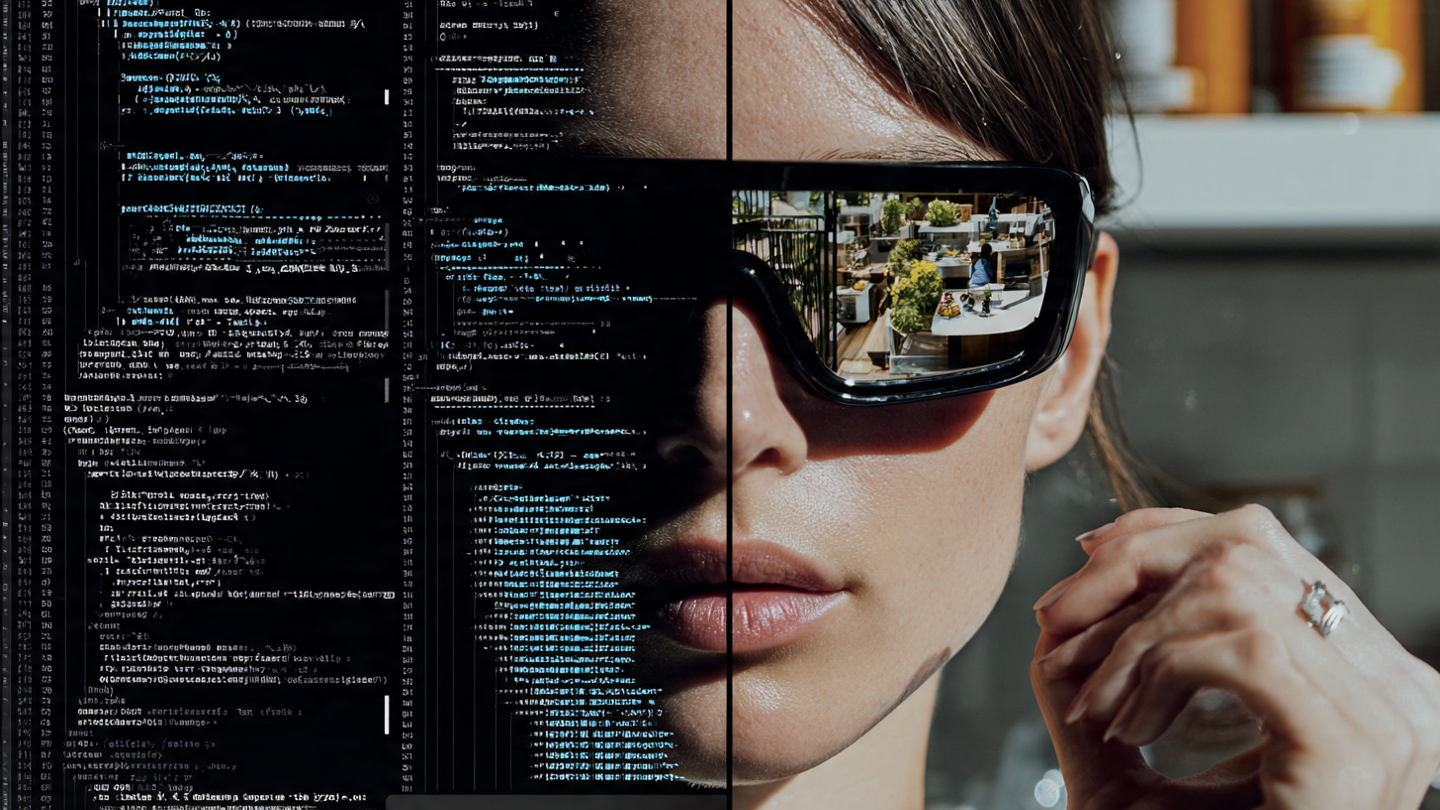
The same mechanic extends to the glasses. You walk through a store wearing Ray-Ban Meta, stop at a pair of sneakers, and ask whether they are worth it. The agent checks the size against your past Marketplace purchases, the price against your budget, whether two friends in your graph have worn something similar. If the answer is yes, you can ask it to order them, and the shopping flow Meta AI already supports on the phone reaches its natural destination: a purchase placed without opening an app, while you finish the aisle.
A Better Place to Be
The competitive field has also shifted in Meta's favor. OpenAI has 900 million weekly active users, but with Codex gaining traction among developers and enterprise contracts becoming the growth engine, OpenAI has started allocating focus and compute that way. The consumer end of the table is where Meta, Google, and xAI now get to play.
Meta's bet is simpler: improve the surfaces it already runs until the AI inside them is a reason to stay, a reason to use more of them, and a reason to reach for the glasses on the way out the door, all without the pressure to monetize the model directly through in-app ads or paid subscriptions.
The AI layer Meta is wiring into WhatsApp, Instagram, Facebook, Messenger, and the glasses makes the ads more relevant, the feed less cluttered, and the shopping query at the end of the aisle something the glasses can close. Every one of those improvements feeds the same engine: the better the model understands the user, the better every surface works, and the better every surface works, the more reason the user has to keep using it. That loop does not need to win the chatbot war. It only needs to run. And it is running.
Meta is a better place to be today than it was nine months ago. And if anyone needed a reminder, one must never bet against Zuck.
Sources
- CNBC, "Scale AI's Alexandr Wang confirms departure for Meta as part of $14.3 billion deal" (June 2025) — Source for the Scale AI deal terms and Wang's move to lead Meta Superintelligence Labs.
- CNBC, "Meta acquires intelligent agent firm Manus" (December 2025) — Source for the Manus acquisition.
- DataCenterDynamics, "Meta estimates 2026 capex to be between $115-135bn" — Source for Q4 2025 capex guidance.
- Fortune, "Meta just bumped its 2026 capex forecast up to as much as $145 billion" (April 2026) — Source for the raised Q1 2026 guidance.
- Wikipedia, "Hyperion (data center)" — Background on the Richland Parish campus.
- IEEE Spectrum, "5GW Data Center Buildout Requires Novel Engineering" — Source for the 5 GW capacity target.
- Meta Data Centers, "The largest Meta data center yet brings big impact to Louisiana" — Source for the campus footprint.
- Fortune, "Meta orders 10 gas-fired power plants for its Hyperion AI campus" — Source for the power supply build-out.
- CNBC, "Mark Zuckerberg says Meta AI has 1 billion monthly active users" (May 2025) — Source for the Meta AI MAU figure.
- SQ Magazine, "Meta AI Statistics 2026" — Source for the 1.2B Q1 2026 figure and 63% WhatsApp share.
- TechCrunch, "ChatGPT reaches 900M weekly active users" (Feb 2026) — Source for the OpenAI WAU figure.
- Meta, "Personal Superintelligence" essay — Zuckerberg's framing of Meta's AI direction.
- Meta, "Introducing Muse Spark, Meta Superintelligence Labs" — Source for the Muse Spark launch.